Monday, March 5, 2012

Sam Adams Alpine Lager.


It's been a while since I've have anything from Boston Beer Company but I saw this seasonal out the other day. An unfilitered lager, it pours exactly the way it sounds. It's just a little hazy, with no obvious particulates. I did notice that appears to be much less carbed than the typical macro: only a few trails of bubbles leading up to the headless surface. Nonetheless, the carbing is most evident all around the edges, leaving a pretty pleasant liquid gold center. The taste is reminiscent of those countless cans of macro but much more mature and refined. It's full-bodied, slightly sweet honey notes, sunshine and amber waves of grain. It's like the college beer that has finally graduated, settled down, put on about 20 pounds, and learned to stop and smell the roses.

I like this beer because it's an easy drinker, still flavorful, and not so thin as to be dismissed without a thought. It should be a nice change of pace in the typical springtime lineup of hefes and wits and the like while bringing a bit more heft to the table than a kolsch or some other craft pilsener. A little lemon might help boost the citrus and cut through some of the body.


  • Appearance: Pale gold, slightly hazy, no head retention.
  • Smell: A rich, grainy aroma. Characteristic lager smell but much heavier and thicker.
  • Taste: Almost hefeweizen-like, slightly sweet. Almost nondescript except for the small points of hop flavor, no bitter, no floral.
  • Mouthfeel: Cohesive and surprisingly heavy but still refreshing. Carb is fairly low and slow, tingling only around the edges.
  • Drinkability and Overall: I like it. It's a nice change of pace from hefes and wits for warm weather beers.


Six Point Righteous Rye Ale.


I liked the Bengali and I like rye ales so this was a natural option. Right off the bat, it is significantly more rye-biased than say GI Mild Winter. I wonder if rye ales are going to be the next trend as I also picked up a rye offering from Sierra Nevada and a imperial rye from Harpoon was on tap at the local shop. In any case, I have somewhat mixed feelings about this. I like rye. But something doesn't jive well with me here. It starts off a little punchy but then there's some weird caramel, soda-ish sweetness. It finishes awkwardly with a bit of a film. I think what bothers me the most is that it doesn't have the weight of cold-weather beer, instead opting for a fairly light and fizzy body.


  • Appearance: Maple syrup brown.
  • Smell: Spicy, slightly fruity.
  • Taste: Obviously rye, but there is some off-putting caramel sweetness.
  • Mouthfeel: A bit over-carbed and light-bodied.
  • Drinkability and Overall: It drinks fine and smoothly, if a bit too much carb bite. Could be construed as refreshing. Not sure if it's just me, but it didn't seem like everything came together properly with this one.


Brooklyn Black Chocolate Stout.


The 11-12 gave a much bigger hiss on popping the cap. The 10-11 is much breadier is both smell and taste. I had initially thought that the 10-11 had taken on a hotter, harsher edge, but comparing against the 11-12, it's actually lighter, smoother, mellower than the 11-12. The 11-12 is pretty up-front with bitter malts, coffee, and even a little boozy heat. The 10-11, I've decided, is bitter in more of a dark chocolate way than anything else. It's just very smooth and dangerously drinkable, leaving not much residue, and the linger is just long enough to be pleasant and short enough to bring you in for more.


Port Brewing Oak-Aged Santa's Little Helper.


As I was pouring, I was surprised by how light this was. Instead of the thick, oily, opaque black pour one normally receives from an imperial stout, this was noticeably tinted brown. An assertive bourbon character is evident in both the nose and initial taste. The barrel aging leaves it boozy but not hot, and there's a slightly dirty, woody taste towards the back end. The more that I think about it though, the bourbon is masking a lot of the expected complexity of an imperial stout. I'm finding it difficult to pick up the typical coffee and chocolate notes, even the dark malts. Even the mouthfeel is somewhat bourbon-y: lighter, cooler, and a bit astringent.

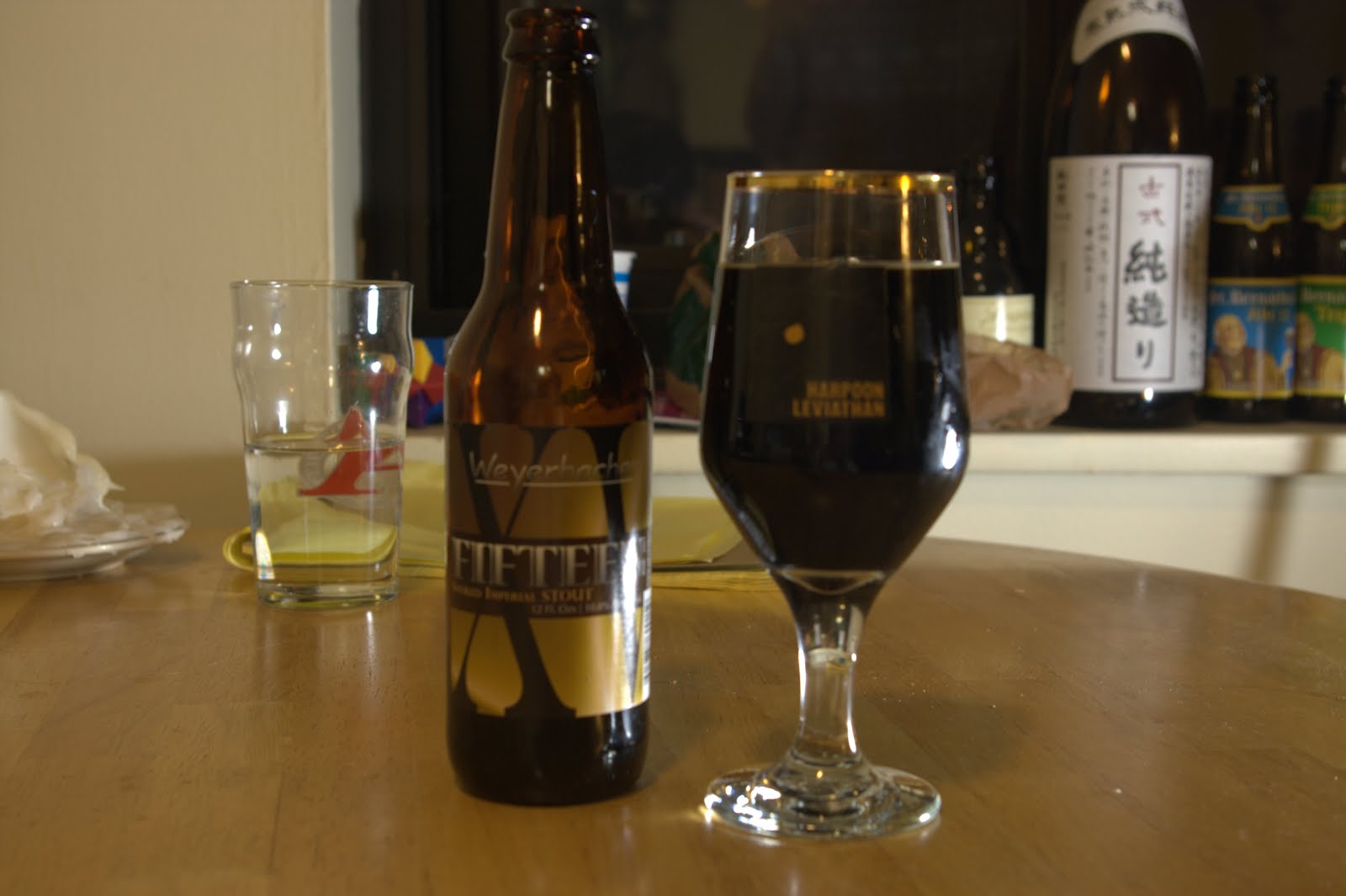
Weyerbacher Fifteen Smoked Imperial Stout.


  • Appearance:
  • Smell:
  • Taste:
  • Mouthfeel:
  • Drinkability and Overall:


Mild smokiness that doesn't bring an overpowering sense of bacon. Predominantly roasted malts with hints of coffee.

Atwater Block VJ Black Imperial Stout.


Yet another bottle that's been taking yup room since before the summer, bottled March 2011. There's lot of fruity sweetness in this one. Fruity coffee nose, fruity sweetness as it lingers on the tongue. Strong, bittersweet chocolate notes with almost burnt malts. The mild carbonation makes it a dangerously easy drinker and the 11%ABV brings no heat.

I think the component I enjoy the most is the cogency of the entire flavor profile. There is an mild bittersweetness that weaves through the chocolate, coffee, and malt notes, but it is far from being cloying. It is clean and smooth, no residue, not on the lips or even the glass. I think I like this one quite a bit. It's a good story.


  • Appearance: Black core, brown around the edges, opaque. Lack of a head is replaced with an oil slick.
  • Smell: Fruity coffee beans.
  • Taste: Overall, a bittersweetness permeates all components: Coffee, chocolate, dark malts.
  • Mouthfeel: Fairly light for an imperial stout. Slick and clean. Ok, if a bit initially biting, carb.
  • Drinkability and Overall: Moves easily but at 11%ABV, exercise caution. A nice change of pace in the imperial stout category with good balance and cohesion.


Scalloped Potatoes and Chestnut Stuffing.