Showing posts with label homebrew. Show all posts

Thursday, February 17, 2011

Mead: Experimental Batches.


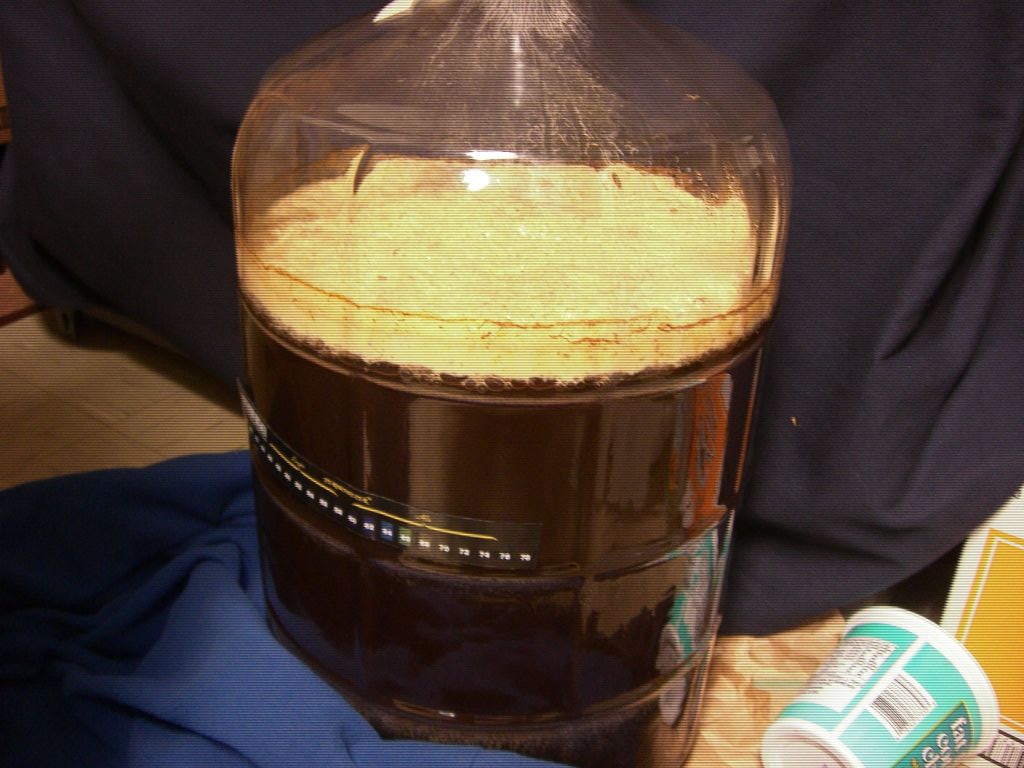
Four of my planned five experimental batches settling out. The Nesquik-based meads have cleared up quite nicely and I racked those. The Liquid Sex is also fairly clear, but I decided to let it sit for a bit longer while I waited for the Leap Year to ferment a bit longer. The Leap Year has been unusually slow. The cake at the bottom is not nearly as substantial as the others, and there's still a stream or two of bubbles coming up from it. Using it to start another may not be a good idea. Besides, I also read that reusing yeast cakes after high gravity brews is not recommended.

I did taste the two meads I racked. Pretty harsh and bitter at the moment. I'm a little concerned since they both measured 1.000 gravity. I didn't have a hydrometer then, but the first batch of AOCC mead I made was pretty sweet still. I used Fleischmann's yeast for that. These batches used Red Star champagne yeast. I wonder if it's an issue with the yeast as my first cider batches were also extremely dry.

I wonder if I can backsweeten with extra honey. Hopefully, it mellows out more, and that won't be necessary. I'll go ahead and rack the Leap Year onto a vanilla bean, but I'm not sure how to proceed next. I could use part of a packet of champagne yeast to start the 5th batch. Or I could just use Fleischmann's since that turned out well. Also thought about carbing some mead. Might just end up brewing up a 5-gallon batch of general purpose mead for various infusions and carbing.


Addendum: I finally got around to racking the other two meads. I did a pour instead of siphon but I was pretty careful with splashing so I figure I'm ok. The cocoa mead had a sweet cake stuck at bottom. I did figure out why my leap year mead had still been bubbling. It has apparently carbed itself. It foamed a bit when I racked, a little more when I dropped in bits of a vanilla bean that I was using in some sugar (along with a bit of sugar). So that's interesting. I didn't taste any of it, but I did get a whiff of some serious alcohol.


Wednesday, January 26, 2011

Double IPA.


Yeast starter with Wyeast American Ale. OG was 1.089, a bit miht higher than the projected minimal so I'm happy about that. Extract kit from NB uses a half pound of delicious hops: Centenni8al, Glacier, Cascade, and Summit with a Cascade dry-hop. Pitched at about 4AM and had a steady bubble in the morning with fragrant rhino farts.

I revamped my brewing schedule for the rest of the year, arranging consecutive extract kits to reuse American Ale yeast cakes throughout the spring. It'll be a tight schedule but should be doable. My summer schedule may be shot as I may be out of town for some extended period of time, but I'll rack long secondaries before that, if that's the case.

Friday, December 24, 2010

Nut Brown Ale.


OG: Supposed to be 1.044. Mine read very low but I think my wort and chilled water were not mixed properly when I took the reading.

Initial tastings were pretty malty and sticky, heavy enough that I didn't want to drink too many pints in a night. I tapped my last draft bottle tonight and it's gotten much smoother. Very on par for a brown ale, though the nuttiness is nowhere near what I'm looking for. At tapping, I lost a lot of CO2, and the first pint couldn't even pour itself. After pressurizing, it came out with a fine, fluffy head.

Addendum 110415: I am about to polish off the last draft bottle of this soon. The extra months of conditioning really smoothed out and lightened up the body and had a sweeter, nuttier taste. Bottom line, this was pretty good but needs a couple months of conditioning to hit its prime.

Belgian Tripel.


OG: 1.071.

Made a yeast starter in my 1L Erlenmeyer. Should really invest in a 2L.

Addendum 110407: After a longer than planned secondary, I bottled tonight into a draft bottle, a case of bombers, and about 2/3 of a case of regular bottles. I used 3/4 cup of dextrose to boost the carbonation a little, hopefully. The recommended 2/3 cup seems to give me low carb levels, but I wonder how much difference 1/12 of a cup will produce. A little concerned about bottle bombs.

Tuesday, November 30, 2010

Breakfast Stout.


It's built as a session beer so I guess I shouldn't expect too much. OG was 1.038, FG was 1.020. Tastes like Guinness Draught with a more chocolate-y and oatmeal tone, less bitterness, and exceptionally smooth.

Thursday, October 28, 2010

Single Hop Best Bitter Tasting.


When I had a taste at bottling, I was a little worried that it was too watery. I pulled a draft from a forced carbed (one week) tap-a-draft. Still kind of watery. It's mellowed a bit and the malt comes in, but I'm used to more full-bodied and hoppier beers. Maybe I was just expecting too much from a straight bitter, which what this is, presumably, as opposed to an ESB, which is what I normally get. The carbing is a little low, though I did tap it a day early.

It's not terrible, but I wouldn't really want to show it off to anyone. It's sessionable in that it has relatively no weight. It's a little like Newcastle, only more unremarkable.

I am undeterred though. I will have to watch my water volume more carefully next time. I had added a little extra in the boil thinking that I would lose some to evaporation and steam, but perhaps that was a bad idea. Also, way more hops. There is also the issue of not letting it condition for very long. Two weeks is the standard, some said 3 weeks. Since beer has to condition anyway, natural carbing is probably the better way to go.

Things to keep in mind for next time. I have a breakfast stout kit already, but I'm planning on picking up a nut brown (always on the search), an IPA that is said to do well with a dry hopping, and a double IPA.

ADDENDUM: It is definitely a session beer. I knocked back 6 pints one night and still felt pretty good.

Tuesday, October 26, 2010

Mead: Experimental Batches.


Set up 4 of 5 experimental batches (1 gallon jugs) of mead the other weekend. 3# of clover honey apiece. All measured OG in the mid 1.080s, but I didn't do a very good job of getting the honey dissolved. I supposed typical OG for mead is 1.120. Clockwise from the back left: Leap Year mead, Liquid Sex chocolate mead, Chocolate mead, Orange Chocolate mead. I used my champagne yeast starter to seed all four jugs.

  • Leap Year: To be racked onto a vanilla bean. Slow start, maybe even slower than the AOCC mead I made last year.
  • Liquid Sex: Original recipe calls for 1# cocoa for a 5 gallon batch. Another thread used 6 oz for 1 gallon and it came out too bitter at tastings. I used 3 oz. Took off surprisingly pretty quickly.
  • Chocolate mead: Used 6 oz of Nesquick. Took off fast (extra sugar in the powder) and busted into the airlock. Attached blowoff but doesn't seem to need it now.
  • Orange Chocolate: Standard JOAM recipe with 6 oz of Nesquick. Also a quick take-off.
  • Orange Vanilla: After racking the Leap Year, I'll reuse the jug for a JOAM+vanilla bean. Thinking about splitting this at racking and adding lactose to half to get an Orange Creamsicle mead.

Also interested in trying this caramel apple mead.

Monday, October 11, 2010

Single Hop Best Bitter.

Brewing my first homebrew beer, a single hop (Fuggle) bitter kit from NB. Steeped some grain.

Wort. The Fuggle pellet hops had a great smell. If this batch turns out well, I might try to use this recipe as a vehicle to try more single-hop beers.


Fermenting. Had trouble bringing my fermenting temperature down so now it's sitting in a kettle of water where I rotate ice packs. Still measuring mid 70's and would like to bring down to high 60's.


Also, here is some champagne yeast starter. I was intending on trying to revive and multiply some dry champagne yeast I had had in my fridge since last year for a set of 4+1 (delayed start) experimental meads I'm planning. Champagne yeast apparently has low flocculation so we'll see how well this actually pans out. In any case, I have an extra pack of dry yeast so I'm covered, and this will just have been practice.

Tuesday, December 22, 2009

AOCC Mead.


As I was racking, the first thing I noticed was the smell. Because it smells awesome. The clove and orange come through a lot with the cinnamon mostly taking a backseat in the bouquet at least. I also found a brilliant way of pumping air into the carboy with a foot pump to push out the liquid below the valve.

I was expecting around a two gallon batch, but I ended up with only 1.5 and the last half gallon coming out a bit cloudy. The sample I tasted was pretty good. I've only had mead a few times (from a pack of Chaucer's) but I think it's pretty spot on. Sweet, spiced, just a little heavier but a long way from honey.

Tuesday, October 20, 2009

Ancient Orange Cinnamon and Clove Mead.

Here is a disgusting looking picture.


This is a pretty popular and classic recipe on the Interwebs that probably every homebrewman tries at some point. I roughly doubled the batch to 2 gallons. It should clear up in about 2 months.

Addendum: Decided I wanted to repost this recipe for posterity's (and my own) sake:

"Ancient Orange Mead (by Joe Mattioli)
1 gallon batch

3 1/2 lbs Clover or your choice honey or blend (will finish sweet)
1 Large orange (later cut in eights or smaller rind and all)
1 small handful of raisins (25 if you count but more or less ok)
1 stick of cinnamon
1 whole clove ( or 2 if you like - these are potent critters)
optional (a pinch of nutmeg and allspice )( very small )
1 teaspoon of Fleishmann’s bread yeast ( now don't get holy on me--- after all this is an ancient mead and that's all we had back then)
Balance water to one gallon

Process:
Use a clean 1 gallon carboy
Dissolve honey in some warm water and put in carboy
Wash orange well to remove any pesticides and slice in eights --add orange (you can push em through opening big boy -- rinds included -- its ok for this mead -- take my word for it -- ignore the experts)

Put in raisins, clove, cinnamon stick, any optional ingredients and fill to 3 inches from the top with cold water. ( need room for some foam -- you can top off with more water after the first few day frenzy)

Shake the heck out of the jug with top on, of course. This is your sophisticated aeration process.

When at room temperature in your kitchen, put in 1 teaspoon of bread yeast. ( No you don't have to rehydrate it first-- the ancients didn't even have that word in their vocabulary-- just put it in and give it a gentle swirl or not)(The yeast can fight for their own territory)

Install water airlock. Put in dark place. It will start working immediately or in an hour. (Don't use grandma's bread yeast she bought years before she passed away in the 90's)( Wait 3 hours before you panic or call me) After major foaming stops in a few days add some water and then keep your hands off of it. (Don't shake it! Don't mess with them yeastees! Let them alone except its okay to open your cabinet to smell every once in a while.

Racking --- Don't you dare
additional feeding --- NO NO
More stirring or shaking -- Your not listening, don't touch

After 2 months and maybe a few days it will slow down to a stop and clear all by itself. (How about that) (You are not so important after all) Then you can put a hose in with a small cloth filter on the end into the clear part and siphon off the golden nectar. If you wait long enough even the oranges will sink to the bottom but I never waited that long. If it is clear it is ready. You don't need a cold basement. It does better in a kitchen in the dark. (Like in a cabinet) likes a little heat (70-80). If it didn't work out... you screwed up and didn't read my instructions (or used grandma's bread yeast she bought years before she passed away) . If it didn't work out then take up another hobby. Mead is not for you. It is too complicated.
If you were successful, which I am 99% certain you will be, then enjoy your mead. When you get ready to make different mead you will probably have to unlearn some of these practices I have taught you, but hey--- This recipe and procedure works with these ingredients so don't knock it. It was your first mead. It was my tenth. Sometimes, even the experts can forget all they know and make good ancient mead."

Wednesday, March 11, 2009

Apfelwein.


One month taste test.

Sorry, picture got wonky during conversion so no picture.

Nice, clear golden color. Somehow carbed itself just the slightest bit. The sourness that was present at bottling has mellowed out, and the apple is starting to show through. Finishes drier than most white wines I've had. Will try it "suß" when I get around to it.

Addendum: tried backsweetening with apple cider, which was meh, and ginger ale, which was ok.

Sunday, March 8, 2009

Apple-Cranberry-Raspberry Hard Cider.


One month taste test

The cork made a nice pop, and there was an immediate raspberry nose. The fermenting was done with Cranberry-Apple juice blend and Montrachet yeast and flavored with raspberry syrup at bottling. At a month's time, I would have expected more carbing, which is pretty light, less than flat soda even. Can't say much about the ABV other than that it's got alcohol in it. Still rather sour and predominantly apple.